Using Science as a Tool for Justice.
Baltimore 2025 311 Service Request Analysis
Baltimore 311 Data Analysis, 2025: Mapping Environmental Burden and Service Gaps
PROJECT OVERVIEW
In 2025, Scientific Research Consultants conducted an independent analysis of Baltimore City’s 311 service request data to better understand how environmental complaints are distributed across neighborhoods.
Using publicly available city data, we examined patterns in:
- Rodent complaints
- Trash overflow and sanitation complaints
- Service request clustering by City Council district
- Temporal trends and potential lag relationships
The goal was simple:
To determine whether public data could reveal structural patterns of environmental burden that may otherwise go unaddressed.
WHY THIS MATTERS
311 data is more than a list of complaints.
It is a real-time signal of neighborhood conditions.
When analyzed thoughtfully, this data can:
- Identify environmental inequities
- Inform sanitation and rodent control strategy
- Guide resource allocation
- Support policy discussions
- Strengthen community advocacy
Communities often experience these issues daily — but without data analysis, their concerns can be dismissed as anecdotal.
We use science to turn lived experience into measurable evidence.
WHAT WE DID
Scientific Research Consultants:
- Aggregated and categorized 311 data across service types
- Defined transparent complaint buckets (Rodent vs. Sanitation-related complaints)
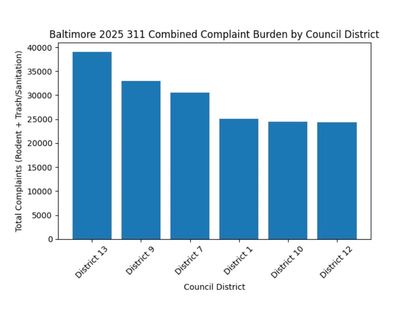
- Calculated total complaint burden by City Council district
- Examined potential associations between sanitation complaints and rodent complaints
- Explored whether trash complaints may precede rodent complaints in subsequent months
The analysis focused on identifying patterns, not assigning blame.
KEY INSIGHTS
Our findings revealed:
- Certain districts experience a disproportionately high combined burden of sanitation and rodent-related complaints.
- There is a measurable association between trash-related complaints and rodent complaints.
- In some districts, sanitation complaints appear to precede increases in rodent complaints, suggesting potential preventable pathways.
These findings highlight the importance of upstream environmental maintenance in preventing downstream public health concerns.
COMMUNITY & POLICY IMPLICATIONS
This analysis demonstrates how:
- Publicly available municipal data can inform proactive public health strategy.
- Sanitation services and rodent control may need integrated planning.
- Council offices and agencies can use data to prioritize high-burden districts.
- Community leaders can use evidence to advocate for equitable resource allocation.
When data is translated clearly and responsibly, it becomes a tool for justice.
OUR ROLE
Scientific Research Consultants specializes in:
- Translating public data into policy-relevant insights
- Identifying environmental and structural disparities
- Supporting community-informed advocacy
- Producing plain-language reports alongside technical analysis
This project reflects our commitment to ensuring that data serves communities — not just systems.
RECOMMENDATION
Baltimore’s 311 data show persistent clustering of rodent and trash overflow complaints in specific council districts, particularly Districts 13, 9, and 7. Rather than treating these complaints as isolated incidents, the City should respond with a targeted sanitation capacity adjustment in the highest-burden areas. While increasing trash collection to multiple times per week could further reduce overflow and rodent access, the labor and operational costs of such an expansion may make it less immediately feasible citywide. We recommend an automatic second city-issued trash receptacle for households in the top complaint districts to better align service capacity with neighborhood conditions. This approach shifts Baltimore from reactive rodent control toward preventive infrastructure solutions. By using complaint data to guide service expansion, the City can reduce repeat 311 requests, lower abatement pressures, and improve block-level cleanliness. A phased rollout beginning in the highest-burden districts offers a practical and fiscally responsible path forward.
If your city or organization would benefit from:
- 311 or municipal data analysis
- Environmental burden assessments
- Equity-informed policy briefs
- Community-focused research translation
We are ready to partner with you.
Project SC-941
When Infrastructure Meets Community Health: Lessons from a $30 million Urban Sewer Project
Project Overview
The SC941 sewer bypass phase was part of a federally mandated infrastructure upgrade under Baltimore’s Consent Decree. Large-scale infrastructure construction in dense urban neighborhoods presents operational, environmental, and community challenges that require coordinated oversight and responsive management.
During implementation, prolonged construction conditions created safety, communication, and environmental health concerns within a historically underinvested neighborhood. Scientific Research Consultants engaged in structured documentation, agency coordination, and evidence-based advocacy to support safer implementation and improved responsiveness.
(Click here to view sample videos)
Our Role
Scientific Research Consultants served as:
• A community accountability partner ensuring concerns were documented and escalated appropriately
• A municipal risk mitigation support resource identifying operational gaps and potential liability exposures
• A systems improvement strategist translating lived experience into actionable institutional recommendations
Our approach combined documentation, data synthesis, policy engagement, and structured communication.
Outcomes Achieved
Through sustained engagement and structured escalation, the following improvements were implemented:
• Initiated hydrogen sulfide monitoring to address air quality concerns
• Supported installation of infrastructure modifications to reduce sewage gas release
• Coordinated improvements to pedestrian safety, detour clarity, and ADA accessibility
• Established consistent weekly project updates between agencies and community organizations
• Assisted in securing residential parking access and temporary relocation accommodations where warranted
• Elevated operational concerns to City Council and executive leadership
• Contributed to issuance of a Department of Transportation stop work order and completion of the stalled phase
These outcomes reduced safety risks, strengthened oversight, and improved institutional responsiveness.
Systems Lessons
This case study highlights the importance of:
• Early environmental health monitoring during infrastructure construction
• Clear communication protocols between agencies and residents
• ADA and pedestrian safety planning prior to installation of temporary infrastructure
• Structured escalation channels
• Transparent documentation practices
• Community-informed oversight frameworks
Infrastructure execution is not only an engineering task. It is a public health and community trust responsibility.
Strategic Value
Scientific Research Consultants supports municipalities, agencies, and community partners in designing infrastructure implementation strategies that:
• Reduce reputational and operational risk
• Strengthen community trust
• Improve interagency coordination
• Ensure equitable project execution
Our work bridges lived community experience with institutional decision-making to strengthen both.

Healing Urban Gardens (HUGs)
Community Climate Resilience & Health Infrastructure Initiative (application funded)
East Baltimore, Maryland
Healing Urban Gardens (HUGs) is a multi-site urban greening and community wellness initiative designed to address environmental health disparities in East Baltimore.
The initiative integrates climate resilience, food access, stress reduction, and community education by transforming vacant and underutilized land into active healing spaces. HUGs was structured to function not only as a garden program, but as preventive public health infrastructure.
SRC’s Strategic Role
We provided strategic development and technical assistance support, including:
• Designed capital and operating grant framework within the BRNI funding structure
• Developed multi-site program architecture and phased implementation strategy
• Integrated environmental health and climate mitigation into project design
• Established measurable impact indicators and evaluation benchmarks
• Aligned academic, environmental, and community partnerships
• Provided administrative, data collection, and program strategy support
The proposal included more than $200,000 in requested capital and operating support, with total infrastructure investments projected to exceed $400,000 across implementation phases.
Public Health & Environmental Objectives
• Increase tree canopy in low-canopy census blocks (baseline approximately 7%)
• Install greenhouse and raised-bed infrastructure
• Support recurring community participation and educational programming
• Expand food access and medicinal plant knowledge
• Reduce urban heat exposure
• Create restorative green space to buffer chronic stress
HUGs positioned greening as preventive health infrastructure rather than beautification alone.
Integrated Evaluation Framework
A defining feature of HUGs was the incorporation of measurable outcomes into the program design, including:
• Tree and canopy tracking metrics
• Participation and engagement data collection
• Environmental exposure mitigation benchmarks
• Health and wellness engagement indicators
• Feasibility and long-term sustainability assessments
SRC led the full development of the proposal, designing the administrative framework, data collection strategy, analytical model, phased implementation plan, programming structure, and overall project alignment as outlined in the submitted initiative.
Project implementation remains contingent upon organizational execution decisions.
Strategic Impact
The proposal was designed to:
• Transform vacant land into long-term public health assets
• Embed climate resilience into neighborhood revitalization efforts
• Integrate measurable health equity indicators into environmental development
• Align community development strategy with environmental justice principles
Workforce & Program Staffing Built Into the Grant Design
The Healing Urban Gardens (HUGs) proposal was structured not only as a greening initiative, but as an employment and workforce development model.
The BRNI grant framework incorporated funding to support key operational roles necessary for long-term sustainability, including:
• Urban Farmer / Garden Manager
• Greenhouse operations support
• Community programming facilitators
• Administrative and evaluation support
• Youth and resident engagement roles
By embedding staffing directly into the capital and operating request, the project ensured that infrastructure investment would be paired with human capacity and neighborhood employment opportunities
This approach positioned HUGs as both environmental infrastructure and local economic activation; strengthening neighborhood ownership, maintenance sustainability, and community participation over time.
Root East Baltimore Initiative

Urban Tree Infrastructure and Climate Resilience Strategy Project Overview (application funded)
Overview
The Root East Baltimore Initiative is a comprehensive urban forestry and climate resilience strategy designed to expand tree canopy, reduce impervious surface burden, and strengthen environmental health conditions in underinvested neighborhoods.
Building upon an existing community tree proposal, Scientific Research Consultants strengthened and restructured the initiative to meet regulatory, budgetary, and implementation standards. SRC designed the administrative framework, refined the data strategy, developed the phased implementation plan, aligned contractor scope, and ensured overall program coherence.
The result was an implementation-ready green infrastructure strategy grounded in community priorities and structured for institutional compliance.
Scope and Infrastructure Design
The initiative was engineered to support:
- Installation of approximately 300 to 350 street trees
- Creation of new tree pits and removal of excess concrete
- Integrated irrigation infrastructure and multi-year watering plan
- Administrative oversight and project management structure
- Community-facing environmental education components
The proposal incorporated detailed capital modeling and operational planning to ensure feasibility and long-term sustainability.
Contractor and Execution Alignment
The project incorporated formal contractor scope and cost alignment, including:
- Tree pit excavation and preparation
- Concrete cutting and removal
- Tree installation
- Multi-year watering and maintenance services plan
Targeted planting corridors were informed by documented block-level site assessments
Strategic Design Framework
Root East Baltimore was structured to:
- Increase urban canopy coverage in heat-vulnerable corridors
- Reduce stormwater runoff and environmental stress
- Improve air quality and pedestrian comfort
- Embed climate resilience within neighborhood revitalization efforts
- Integrate measurable environmental and public health indicators into infrastructure planning
This initiative reflects SRC’s capacity to translate community vision into structured, fundable, and execution-ready environmental infrastructure strategy.
The initiative was structured to create opportunities for contractor engagement and local workforce participation during installation and maintenance phases.